Introduction
There was a time in mathematics when geometry was the main tool for providing rigorous proofs. That was especially true during the time of classical antiquity. But it remained true long after: a geometry-based proof was considered the purest and most rigorous proof possible, and arguments that deviated from this gold standard were routinely met with the demand that they be redone in the manner of the ancients.
This continued well into the seventeenth century. Algebra and the other new methods were young, and a geometric proof was still the preferred one, and it was regarded as the nobler and more elegant form of argument.
Bonaventura Cavalieri, a student and later close friend of Galileo, lived squarely in that transition. He knew the new methods of symbolic algebra, but for his own work — above all in the early part of his mathematical career — he chose to stay with the ancients and with the geometric standard. Working (mostly) under that constraint, he still arrived at results no one had reached before.
And because he worked with the same tools the Greeks had, his writings tell us something we cannot get from the Greeks themselves: what the road to discovery may actually have looked like. The surviving classical texts do not show that road. They present the finished proof — a clean deductive chain resting on a small set of axioms, watertight and beautiful, but completely silent about how anyone arrived at the statement in the first place. Cavalieri and others suspected as much. They assumed that the ancients had probably used some such method to find their theorems and then withheld it. This turned out to be right, though Cavalieri never lived to see the evidence: Archimedes' Method, in which exactly that kind of heuristic reasoning is spelled out, resurfaced only in 1906.
This story follows Cavalieri's reasoning for determining the integral of \(x^n\) — or the quadrature of the parabola and of the higher powers, as one would have said back then. Cavalieri found a purely geometric derivation (at least for \(n=2\)) based on what is now known as Cavalieri's principle and his method of indivisibles. It is arguably one of the most beautiful arguments of the seventeenth century. Although the quadrature of the parabola itself was nothing new — Archimedes had already solved it long ago — Cavalieri's method stood out because he was able to extend it to higher powers. More broadly, it marked an important step toward the modern idea of an integral.
The Method of Indivisibles
Cavalieri's approach to the task of determining areas or volumes of non-trivial shapes could in some sense be summarized as reducing the question of equality of areas by one dimension. He observed that if one fixes a direction and cuts two figures by parallel lines in it, and can show that each of these lines equals the corresponding line of the other figure, then the two areas are equal as well. This collection of parallel lines he introduced as a new object, which he called omnes lineae ("all the lines"). The direction is part of the definition: he always specifies a regula, a reference line fixing the direction of the cuts, and two figures may only be compared with respect to the same regula. The illustration below visualizes Cavalieri's idea of the omnes lineae.
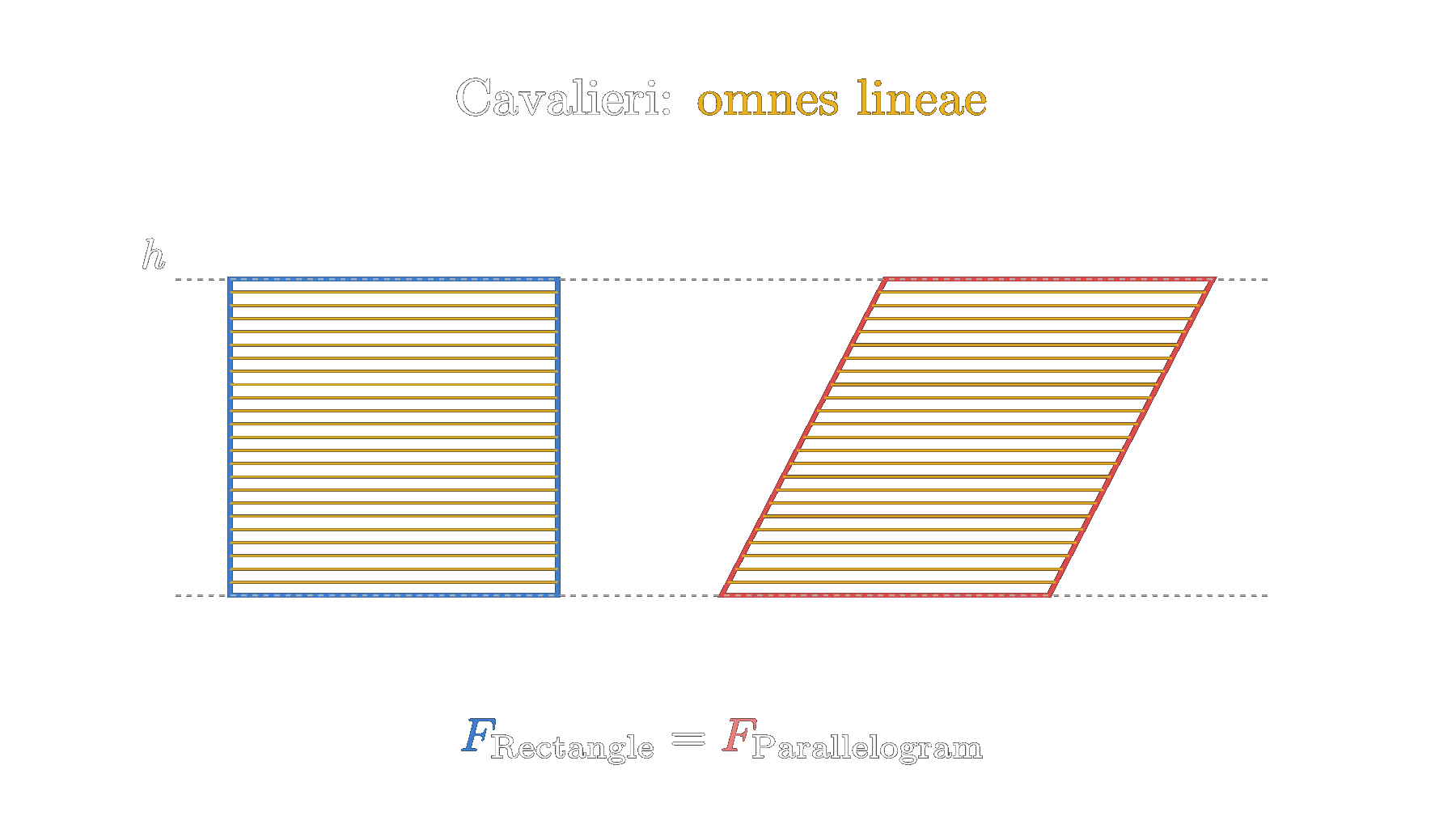
Cavalieri extended the idea also to figures that are not equal. Here he considers the ratio of all the lines: once it is known in what ratio two such collections of lines — the omnes lineae — stand to each other, the areas stand in that same ratio.
That this is more than a leap of faith rests on the framework Cavalieri is working in: the Eudoxian theory of proportion, as Euclid sets it out in Book V of the Elements. In that theory, magnitudes are never evaluated — no number is ever assigned to a line or an area — but magnitudes of the same kind may be set into ratio with one another, and ratios may be compared.
This is precisely what underpins Cavalieri's approach: he never has to say how large omnes lineae is, a question that would be meaningless anyway, since the collection consists of infinitely many lines. He only has to say how one collection stands to another — and a ratio between two collections is a legitimate object of the classical theory, even when the collections themselves elude measurement. And that is indeed all he claims: not that a figure is the sum of its lines, but that two collections of lines are to each other as their figures are. The dangerous question of composition — whether an area can be built up from breadthless lines — never has to be answered, because the theory of proportion never asks it.
This does not make the method fully rigorous, though, because whether an infinite collection of lines is a magnitude in the sense of the Eudoxian theory of proportion is certainly debatable — and it was already debated in his own time: Paul Guldin heavily criticized Cavalieri's method of indivisibles.
The Area under a Parabola
Whatever its foundational difficulties, the method proved remarkably effective. To see it at work, let us return to the original problem and start with the simplest non-trivial case: the area under \(y = x^2\) with respect to the vertical regula. At each \(x\) the ordinate has length \(x^2\), so the omnes lineae of this figure is a collection of segments whose lengths grow as the squares of a linearly growing quantity.
As mentioned above, Cavalieri's method rests solely on ratios, so we first have to choose a figure with which to compare the parabola. A fitting candidate for that is to choose the enclosing rectangle. The omnes lineae of this rectangle is a collection of lines which are all of the same size. Determining the area in the sense of Cavalieri's method means finding the ratio between the omnes lineae of the parabola and of the enclosing rectangle.
Let us begin by examining the omnes lineae of the parabola in more detail. One might realize that they can be interpreted as actual squares, whose side length here increases uniformly. The natural geometric picture — and also the one Cavalieri came up with — is to stack these squares on top of one another. Because the side lengths grow linearly, the infinite collection, that is the omnes lineae interpreted from this different perspective, then neatly forms a pyramid. This idea is shown in the following image.
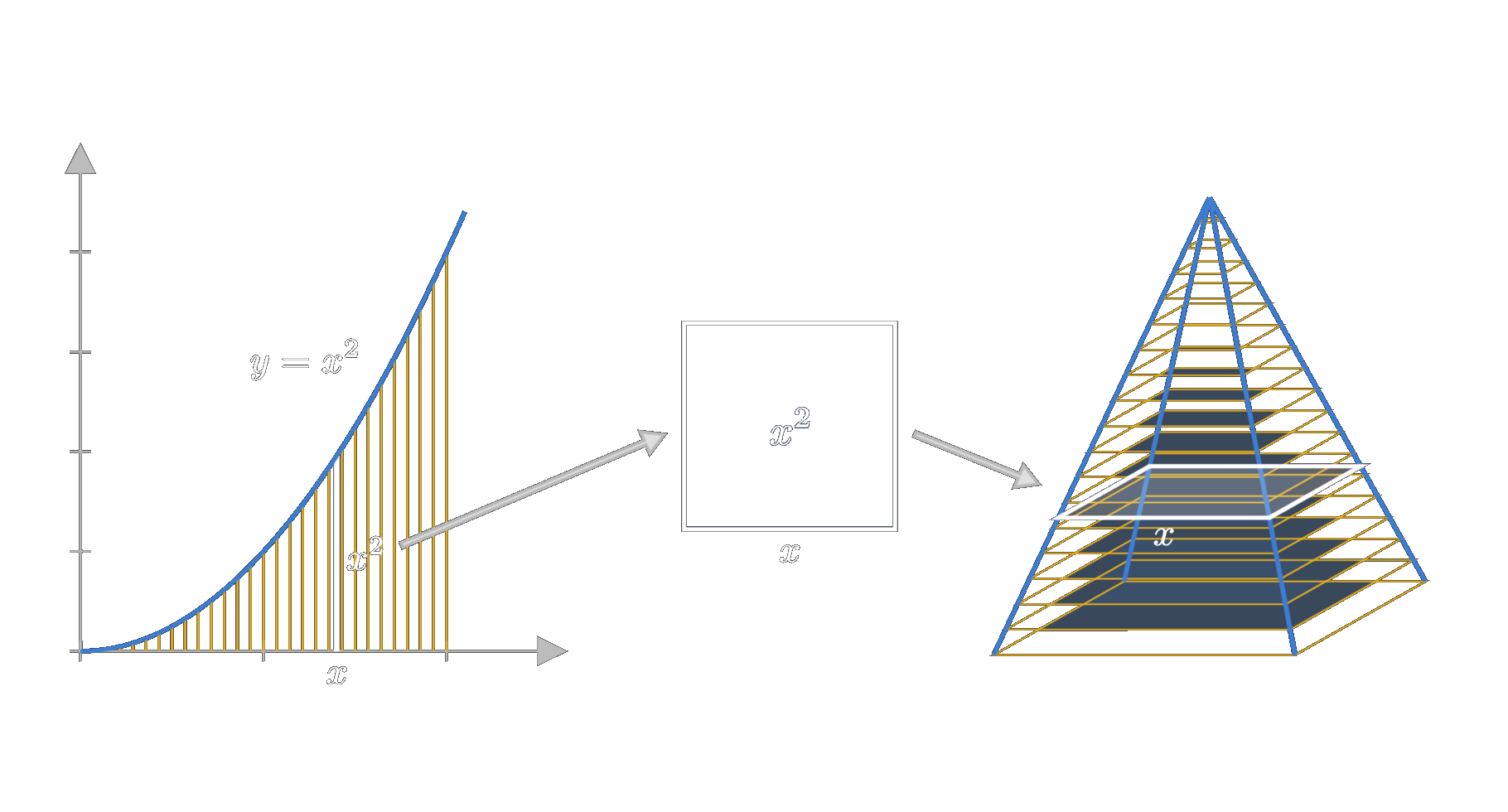
On its own, this picture does not yet yield anything usable: it restates the problem in three dimensions without solving it. But it does reveal something interesting: By moving this one dimension up, that is, by interpreting the vertical lines as actual squares, we basically brought the parabola one degree down, to a linearly increasing figure: a triangle (or a pyramid when visualizing the actual squares but one could also stick to one dimensional cut lines just that the squared value of those is considered). The two different perspectives in the figure above essentially ask for the same thing. The question is whether we can use this second perspective to somehow determine the area of the parabola.
Cavalieri tries to make progress by looking for similar figures — similar triangles because that is what the new perspective gave us. The guiding idea is to find a triangle that contains the same constellation again, only in smaller proportion. If that succeeds, the large and the small copy can be related to each other, and from this relation a general formula may fall out. The constellation Cavalieri found, and the one he illustrates in his treatise, is a parallelogram cut by a diagonal into two congruent triangles. He probably chose a parallelogram rather than a rectangle simply because it is the most general figure for which this works; for simplicity one may just as well stick to a rectangle. In the following image this parallelogram is shown (by the way, if you want to admire Cavalieri's original stunning drawing of the parallelogram have a look at Geometria II, Theorema XXIV, Propositio XXIV, page 159 in his publication Geometria indivisibilibus continuorum, 1635).
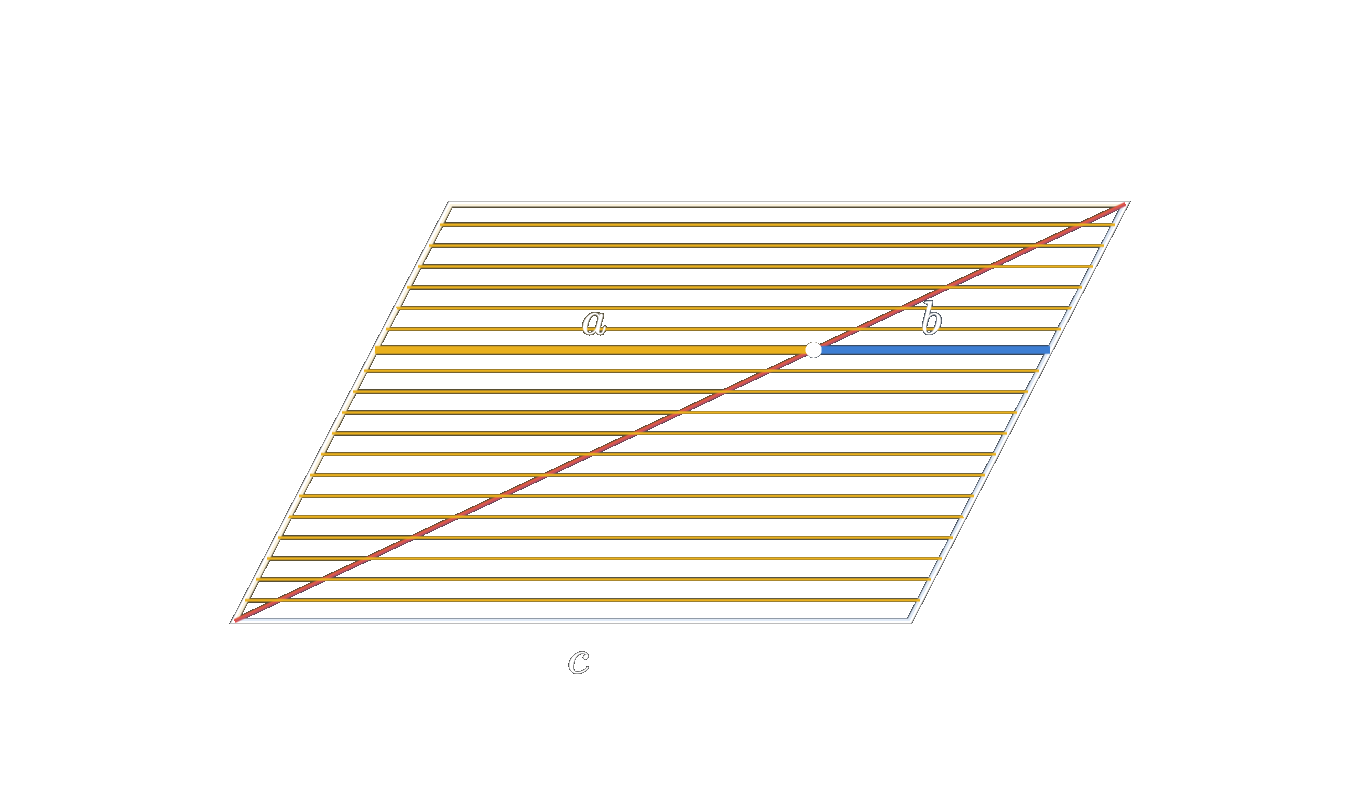
We see the omnes lineae of the parallelogram, taken with respect to one of its sides. At every height the line is cut in two by the diagonal, one part falling inside one triangle, the other part inside the other. Call the width of the parallelogram \(c\) and the two parts belonging to the respective triangles \(a\) and \(b\) and we have \(a + b = c\) at every height.
The similar triangles of smaller proportion arise from a second cut in this figure: divide the parallelogram along its midline, the line parallel to the sides at distance \(\tfrac{c}{2}\), as illustrated in the following image.
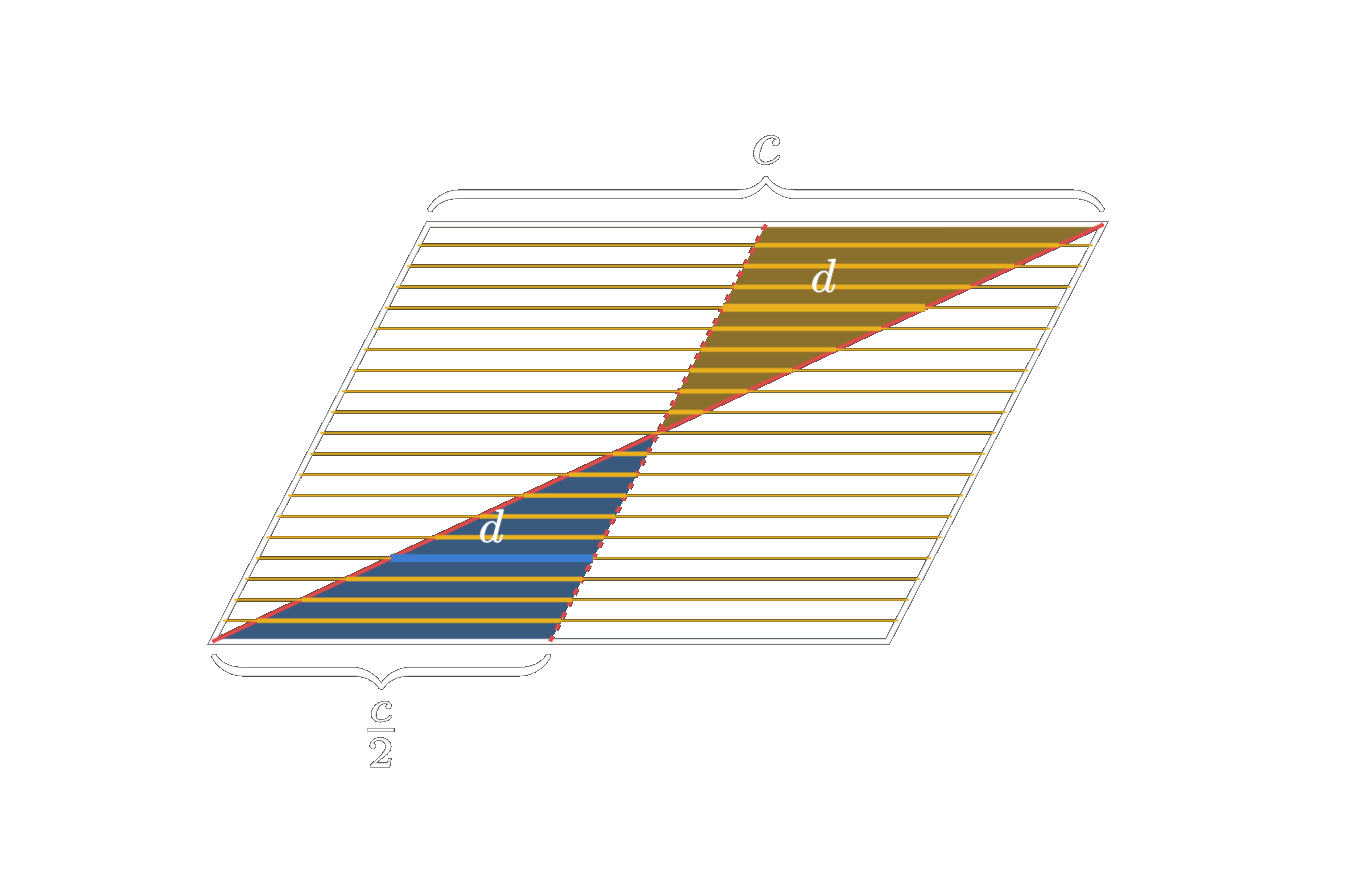
The two smaller triangles are exactly what we were looking for: each is similar to the large triangles, at half the scale to be accurate. Their omnes lineae are the differences between the midline and the diagonal, that is, \(d = a - \tfrac{c}{2}\) in the one half and \(d = \tfrac{c}{2} - b\) in the other. Remember, squaring them again gives a pyramid, which directly corresponds to the omnes lineae of a parabola.
Omnia Quadrata
We have already mentioned the idea of squaring the omnes lineae when we claimed that stacking the squares into a pyramid essentially reduces the parabola to a triangle. To make use of this, we do not actually have to erect the squares: we can stick to the one-dimensional cut lines and simply consider the squared length of each of them. Let's make this idea precise. Cavalieri is not talking about squaring one individual line; instead, just as with the omnes lineae, he treats the totality of squares as an object in its own right: every line of the figure drawn parallel to the regula is squared, and the collection of all these squares is called the omnia quadrata of the figure. As before, equality and ratios between omnia quadrata translate directly into equality and ratios of the corresponding volumes.
With that in mind, we can now work out the exact relation between the omnia quadrata of the large triangles and of the parallelogram itself making use of the similarity to the small triangles.
The Geometric Binomial
In order to see how this ratio can be obtained, fix a concrete height and look at the single line there. It is divided by the diagonal into \(a\) and \(b\), and each of these is in turn divided by the midline into \(\tfrac{c}{2}\) and \(d\). Then we visualize their corresponding omnia quadrata at that height by drawing the corresponding squares. This is shown in the following image.
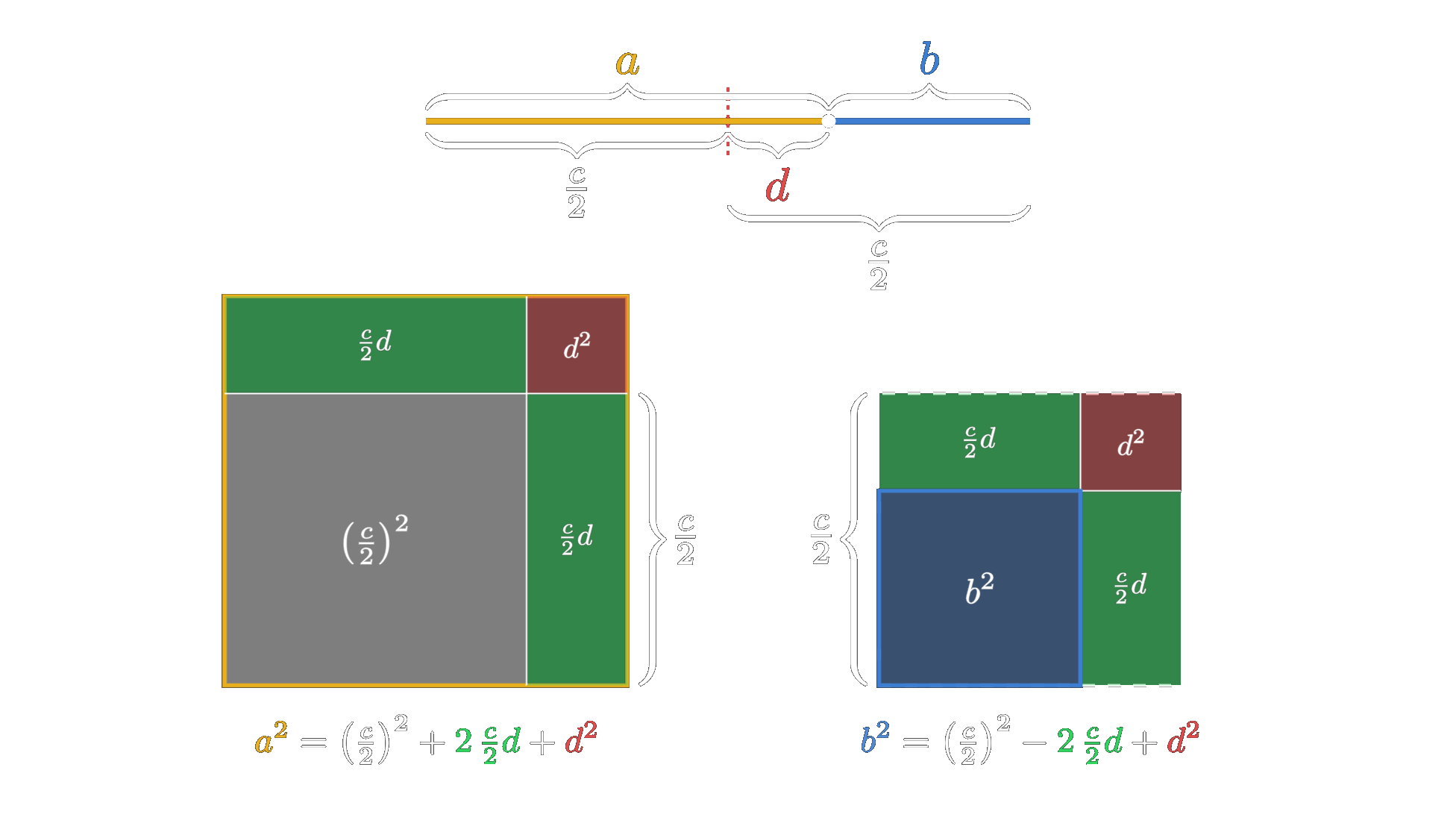
This is exactly the visual interpretation of a binomial term like \((a+b)^2\) — and we will also see that for the generalizations to higher dimensions, that is, to the problem of finding the area under \(x^n\) the binomial expression \((a+b)^n\) has to be considered.
Continuing with our 2-dimensional case, we read off directly that
\begin{equation} a^2 = (\tfrac{c}{2})^2 + 2\,\tfrac{c}{2}d + d^2 \end{equation}and
\begin{equation} b^2 = (\tfrac{c}{2})^2 - 2\,\tfrac{c}{2}d + d^2. \end{equation}This allows us to make a new statement about the omnia quadrata of the two large triangles: for every cut line we have
\begin{equation} a^2 + b^2 = 2(\tfrac{c}{2})^2 + 2d^2 = \tfrac{c^2}{2} + 2d^2. \end{equation}Since the mixed terms cancel in the sum both \(c^2\) and \(d^2\) once again admit a pleasing geometric reading as omnia quadrata — and by now it should slowly be becoming clear where this journey is headed.
The Ratio between a Pyramid and a Prism
Cavalieri now considers the totalities of squares — the omnia quadrata — of all the figures involved.
Recall that the geometric pyramid, that is, the omnia quadrata of a triangle, represents exactly the area under a parabola. Following the original text, let us call it \(T\).
First, we have the omnia quadrata of the horizontal segments \(a\) and \(b\). Each of these forms a pyramid, so together their totality of squares amounts to \(2T\).
The omnia quadrata of the whole parallelogram — every single cut line being \(c\), squared — simply reproduces the volume of the enclosing paralleloid; call it \(P\).
Finally, the totality of \(d^2\) corresponds to the omnia quadrata of the smaller triangles. Since these are similar to the large triangles at half the scale, their totality can be expressed in terms of \(T\). A tempting shortcut is to go by the count of the cut lines: halving the triangle halves every line, so the omnia quadrata shrinks to a quarter — and since the triangle is now only half as wide there are consequently only half as many lines, which yields one eighth for the totality. However, this is precisely the kind of reasoning Cavalieri avoids. Speaking of "half as many lines" treats the omnes lineae as a heap of infinitely many individual lines that can be counted, and that is exactly the question of composition the theory of proportion allowed him to sidestep.
Instead, Cavalieri's argument runs through the figures themselves. When the sides of a solid are scaled by a given factor the volume scales with the cube of the scaling factor. Since the omnia quadrata of the small triangle and that of the large one stand in the same ratio as the pyramids they form, this cubic scaling also holds for the omnia quadrata.
In our case the small triangles are half the size of the large ones, so by the triplicate ratio the omnia quadrata of each is \(\left(\tfrac{1}{2}\right)^3=\tfrac{1}{8}\) of \(T\). One important nuance we have to be careful with, though: Since we consider the omnia quadrata for \(d\), we consider all horizontal \(d\) lines squared from the bottom to the top of the parallelogram, and hence we will always include both smaller triangles. Therefore the totality of \(d^2\) will be one fourth of \(T\).
With that in mind, let us consider now the totalities of squares, the omnia quadrata, in our relation
\begin{equation} a^2 + b^2 = \frac{c^2}{2} + 2d^2 \end{equation}where we obtain
\begin{equation} 2T = \frac{P}{2} + 2 \cdot \frac{T}{4} = \frac{P}{2} + \frac{T}{2}. \end{equation}After some short rearrangement we easily see that
\begin{equation} \frac{3}{2}T = \frac{P}{2}, \end{equation}in other words, the omnia quadrata of the paralleloid stands in the ratio \(3:1\) to the omnia quadrata of the large triangle.
Translated into volumes, this means that the paralleloid — and, in general, the enclosing prism — has three times the volume of the inscribed pyramid.
As mentioned at the outset, the pyramid is nothing but the three-dimensional interpretation of the infinite collection of squared ordinates of the parabola. The omnia quadrata of the parallelogram, in turn, is the largest cut line squared taken as constant over the whole range. Since in the parabola the ordinate is already squared, this constant line squared is simply the largest \(y\)-value, \(X^2\), up to which we wish to determine the area. Taken constantly over the interval, it corresponds to the enclosing rectangle.
We can therefore conclude that the area under the curve \(y = x^2\) is one third of the area of the enclosing rectangle. Since this rectangle has area \(X^2 \cdot X = X^3\) in general (where \(X\) is the \(x\)-value up to which we want to determine the area), the corresponding area under the parabola is \(\tfrac{X^3}{3}\).
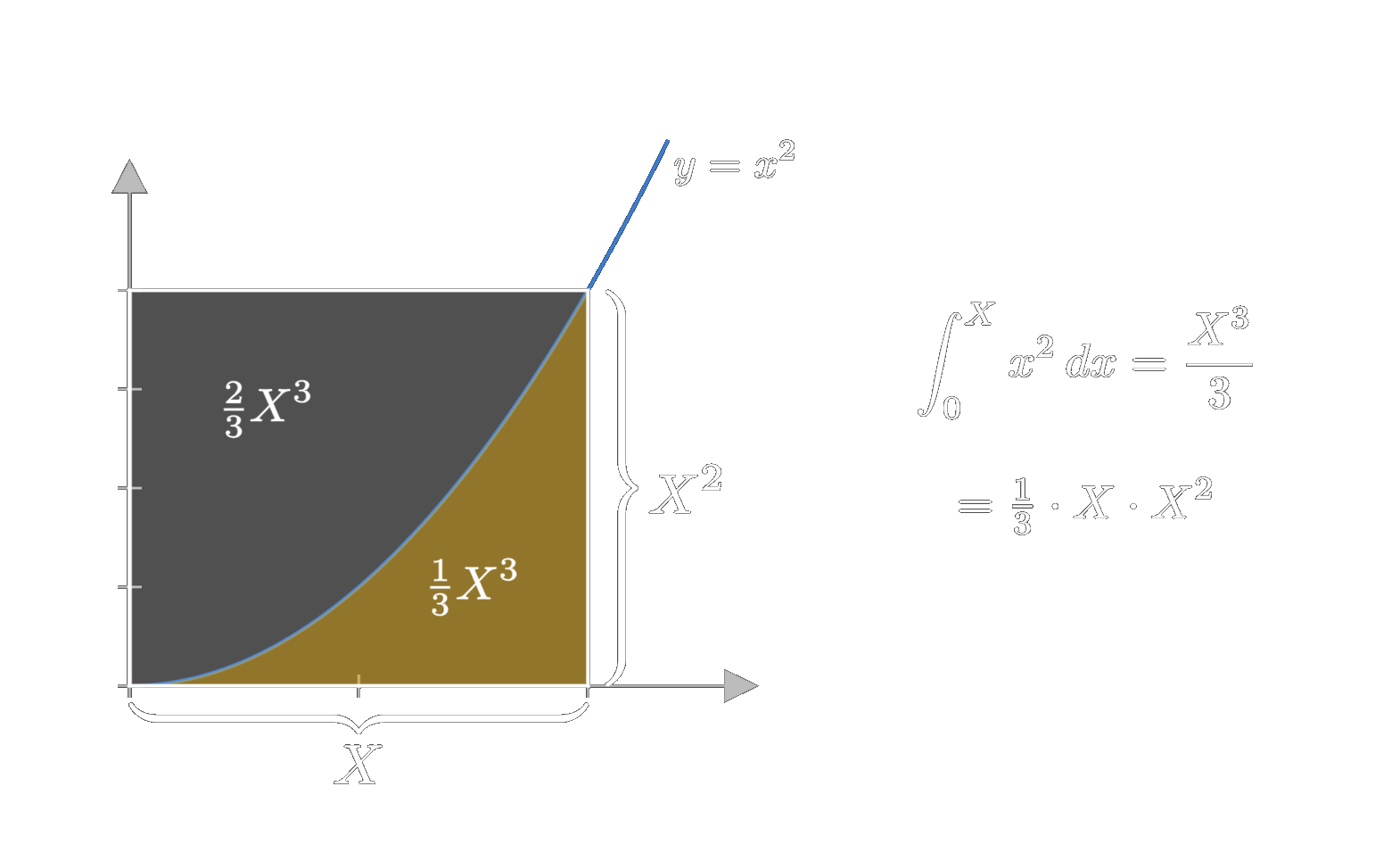
In integral notation, we have just shown that
\begin{equation} \int_0^X x^2\, dx = \frac{X^3}{3} \end{equation}holds. So, to summarize, the parabola takes always one third of its enclosing rectangle.
Generalizing to Higher Powers
Turning to higher powers, one quickly sees what the ordinates of \(y = x^3\) ask for: cubes. At each \(x\) the height is \(x^3\), so we are now summing three-dimensional cubes whose side length grows linearly. Stacked as before, they once again form a pyramid — only this time a four-dimensional one.
That, however, changes nothing essential, and we may proceed with exactly the same parallelogram as before. In place of the omnia quadrata we now consider omnes cubi, and once again the task is to express \(a^3 + b^3\) geometrically through the binomial in \(\tfrac{c}{2}\) and \(d\).
Since everything is now raised to the third power, the binomial picture itself becomes a cube. As before, \(a\) is the part to which \(d\) must be added and \(b\) the part from which it must be subtracted. The following image illustrates this.
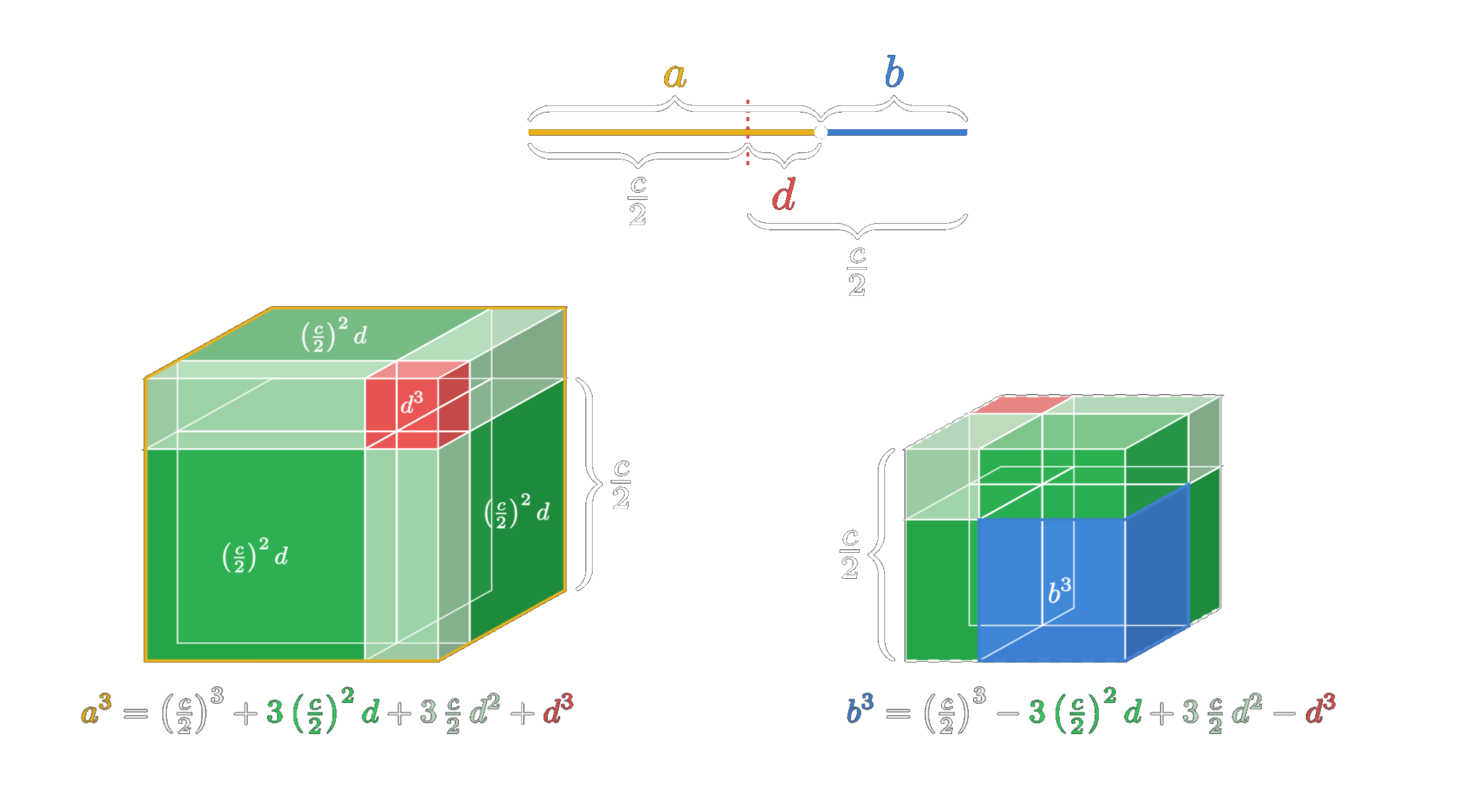
For \(a\) we simply count all the blocks together, which gives
\begin{equation} a^3 = \left(\tfrac{c}{2}\right)^3 + 3\left(\tfrac{c}{2}\right)^2 d + 3\,\tfrac{c}{2}\,d^2 + d^3. \end{equation}For \(b\) we need differences instead: from the \(\tfrac{c}{2}\) cube we must peel away the shell that the subtraction of \(d\) carves out. We begin by removing the three plates \(\left(\tfrac{c}{2}\right)^2 d\). In doing so, each of the three edge blocks has been removed twice and the small \(d\) cube three times, so we must add them back once each — that is, \(+\,3\,\tfrac{c}{2}\,d^2\), which at the same time restores exactly three \(d\) cubes. Since the \(d\) cube itself does have to go, a final \(-\,d^3\) remains, and altogether
\begin{equation} b^3 = \left(\tfrac{c}{2}\right)^3 - 3\left(\tfrac{c}{2}\right)^2 d + 3\,\tfrac{c}{2}\,d^2 - d^3. \end{equation}For the sum \(a^3 + b^3\) we consequently obtain
\begin{equation} a^3 + b^3 = 2\left(\tfrac{c}{2}\right)^3 + 6\,\tfrac{c}{2}\,d^2. \end{equation}Compared with the parabola, we are not so lucky this time: the relation is no longer built solely from terms that can be read off directly as omnes cubi. The mixed term \(\tfrac{c}{2}\,d^2\) survives the summation, and this is a genuine obstacle — it is precisely what makes the case \(n = 3\) markedly harder than \(n = 2\).
The trick is to tame this term with what we already know: the omnia quadrata results of the previous section. Observe that the mixed term is the product of a constant length and a square. The width \(c\) is the same on every cut line, so taking the totality of all \(\tfrac{c}{2}\,d^2\) amounts to taking the totality of all \(d^2\) and stretching it by the constant factor \(\tfrac{c}{2}\). But the totality of the \(d^2\) is an old acquaintance: it is the omnia quadrata of the two small triangles, which we determined to be one twelfth of the omnia quadrata of the parallelogram — that is, one twelfth of the totality of the \(c^2\). Stretching by \(\tfrac{c}{2}\) then turns each \(c^2\) into half a \(c^3\), and so the totality of the mixed term is one twenty-fourth of the totality of all \(c^3\) — one twenty-fourth of the cubed paralleloid.
Let us now, as before, pass to totalities in our relation, writing \(T\) for the omnes cubi of a large triangle and \(P\) for those of the parallelogram. The left-hand side gives \(2T\) by congruence; the first term on the right gives \(2 \cdot \tfrac{1}{8} P = \tfrac{P}{4}\); and the mixed term, by the argument just given, contributes \(6 \cdot \tfrac{P}{24} = \tfrac{P}{4}\). Altogether
\begin{equation} 2T = \frac{P}{4} + \frac{P}{4} = \frac{P}{2}, \end{equation}and hence \(T = \tfrac{P}{4}\): the omnes cubi of the paralleloid stands in the ratio \(4:1\) to the omnes cubi of the large triangle.
Translated back down, the reading is the same as before. The omnes cubi of the parallelogram is the largest ordinate \(X^3\) taken constantly over the whole interval — the enclosing rectangle of area \(X^3 \cdot X = X^4\) — and the area under the curve is one fourth of it. In integral notation,
\begin{equation} \int_0^X x^3\, dx = \frac{X^4}{4}. \end{equation}The pattern of the argument is worth pausing over. Each power leans on the powers below it: the mixed terms that the binomial leaves behind are of lower degree, and they can only be dissolved because the corresponding lower totalities have already been determined. The whole construction is, at heart, a recursion — and an increasingly laborious one, since with every step the binomial sheds more mixed terms that all have to be reduced in this fashion. For \(n = 4\) one faces the mixed term \(c^2 d^2\), for \(n=5\) it is already \(c^3d^2\) and \(cd^4\), and so on. In general the odd powers of \(d\) will cancel while the even ones survive. Hence every second step in \(n\), the problem gets one term more complex. Cavalieri fought his way up this ladder rung by rung, reaching \(n = 9\) in his Exercitationes geometricae sex of 1647, and from the pattern he conjectured the general rule — that the enclosing prism stands to the pyramid of the \(n\)-th powers in the ratio \((n+1):1\), which in our notation is nothing other than \(\int_0^X x^n\,dx = \tfrac{X^{n+1}}{n+1}\).
The general case was settled by others, and by different means. Fermat found an elegant argument that handles all powers at once — indeed even fractional ones — by subdividing the interval not uniformly but in geometric progression, so that the resulting sums become geometric series that can be evaluated in closed form. Pascal, in turn, attacked the sums of powers arithmetically, deriving a recursion for them from the binomial coefficients (as we have just seen the problem is indeed heavily connected to the binomial) that delivers every exponent in one stroke. Roberval and Torricelli reached the result independently as well.
It is worth being honest about what has happened along the way, though. The argument for \(n = 3\) can still be told in blocks and plates, but the bookkeeping of the binomial — and above all the recursive reduction of the mixed terms — is algebra in geometric dress. The higher one climbs, the thinner the dress becomes. The purely geometric proof, so complete and self-contained for the parabola, does not really survive the generalization fully intact (or at least it gets very complex to see everything by this way); and Cavalieri himself, in his later work, increasingly availed himself of precisely these arithmetical and algebraic devices. The gold standard of the ancients had carried him remarkably far — but it is here, at the higher powers, that one can watch the new mathematics quietly taking over.