Introduction
All of us are familiar with the formulas for the area of a circle, that is \(r^2\pi\), and its circumference given by \(2\pi r\). But have you ever wondered why it is actually the same \(\pi\) in both of them? The circumference is a length, the area, well, is an area — there is no obvious reason why the number that tells us how often the diameter fits around the circle should also be the number that tells us how often the square on the radius fits into it. Needless to say, if you pause for a moment and start to reflect on that, you will see it is not a hard question to answer why this is indeed the case. The first rigorous proof of that, however, was already provided a few thousand years ago. And back then, the answer to the question was not so obvious at all. So in this story we are going to explore the chain of reasoning of Archimedes as he proved that the area of a circle is actually related to the area of a triangle with the circumference as one of its sides. And it is quite an elegant proof he presents in his treatise called Measurement of a Circle because he completely avoids any notion of the infinite.
Diving into his work, its very first proposition reads (more or less word for word): Every circle is equal to a right-angled triangle in which one of the sides about the right angle is equal to the radius, and the other to the circumference of the circle. In other words, if you take the circumference \(C\) of a circle, straighten it out into a line, and erect the radius \(r\) perpendicular on one of its ends, the triangle you get has exactly the same area as the circle.
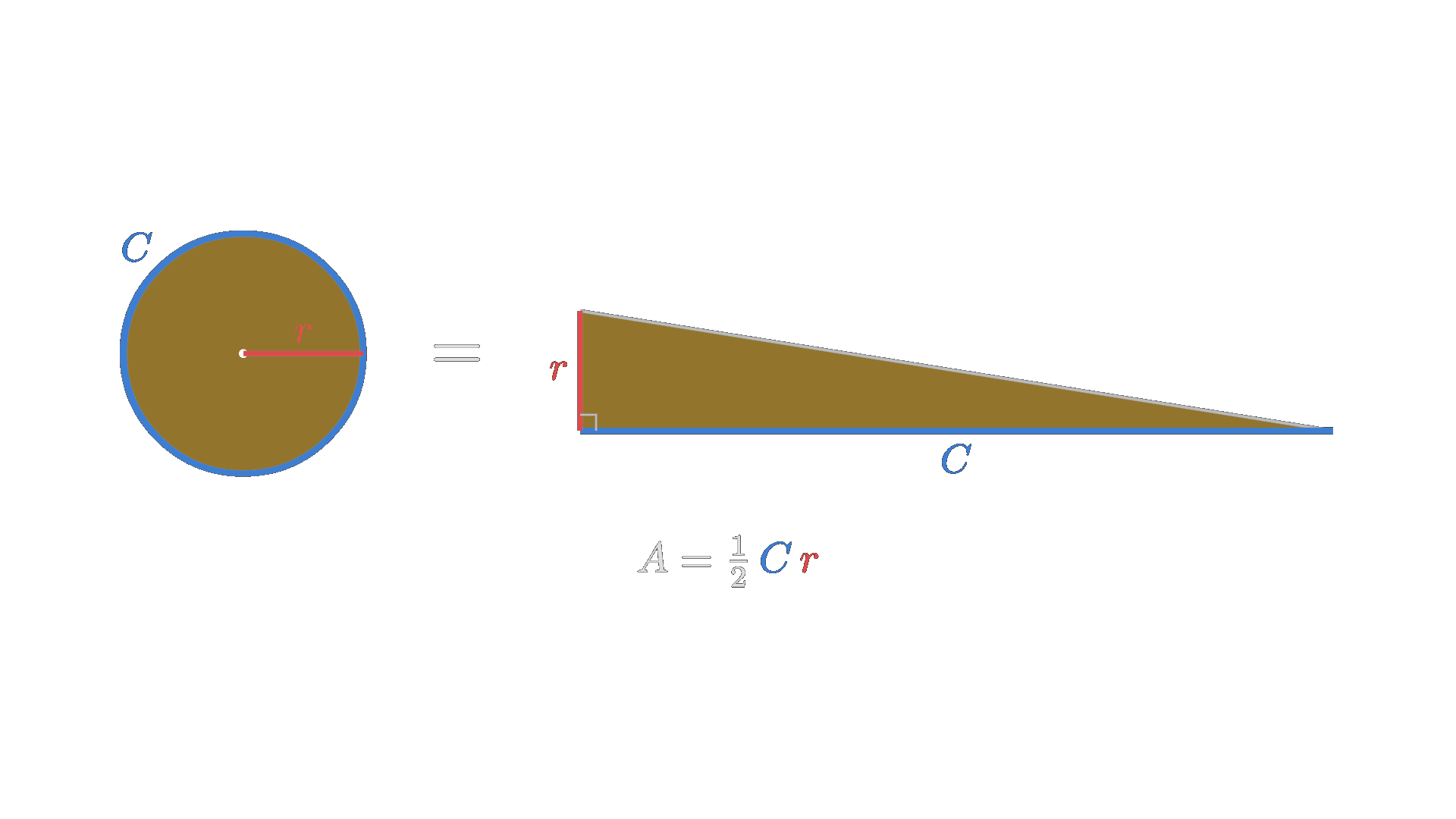
Written as a formula that yields
\begin{equation} A = \frac{1}{2}\,C\,r, \end{equation}and if we plug in \(C = 2\pi r\), then we get the familiar \(A = \pi r^2\). So this little statement is precisely the bridge between the two formulas for the circumference and the area. Mind you, it does not solve the famous problem of the quadrature of the circle — it shifts it from the area to the circumference and shows that solving one also solves the other, a point we already touched on in the story Seeking an Expression for π — Wallis' Audacious Adventure.
In this story we will first look at why Archimedes' claim is indeed true by outlining a few very inlightning visual perspectives — and then at how Archimedes actually proved it, because that is a completely different matter. The Greeks had very strict standards about what counts as a proof, and the intuitive pictures would not have passed them.
Comparing Figures instead of Computing Areas
Before we start, it helps to keep in mind how the Greeks thought about areas at all. As we have seen in the story Cavalieri — Solving the Integral of xⁿ with Nothing but Geometry, they never assigned a number to a length or an area. Magnitudes were compared with each other, either as equal or in a certain ratio. "Determining the area" of a figure meant finding a simpler figure that is equal to it, ideally one that could be constructed with straightedge and compass.
For figures bounded by straight lines this was completely straightforward. Any polygon, for example, can be cut into triangles, and for triangles Euclid's Elements provides everything that is needed. Two results will be particularly important for us. The first is Proposition I.41: a triangle is half of the parallelogram with the same base and the same height. The second is Proposition I.38: triangles on equal bases and between the same two parallel lines are equal. That second one means that we can slide the tip of a triangle along a line parallel to its base as much as we like, the area does not change. Keep that in mind, we will use it in a moment.
Curved figures, however, were a different story. What the Greeks did know about the circle is recorded in Proposition XII.2 of the Elements: circles are to one another as the squares on their diameters. The proof is usually attributed to Eudoxus, the same Eudoxus whose theory of proportion Cavalieri was relying on. Translating it into modern terms it says that the ratio \(\tfrac{A}{d^2}\) is the same for all circles (so that the area of a circle scales exactly as \(r^2\)). But it does not say what that ratio is, and it does not connect it in any way to the circumference. The latter is exactly what Archimedes solved.
Cutting the Circle into Slices
So let us try to see why a circle should be equal to that triangle. The most straightforward idea is probably to just cut the circle like a cake into many thin slices. Each slice is a sector: two straight sides of length \(r\) meeting at the center, and a short arc on the outside. If the slices are thin enough, each one looks almost like a triangle whose height is the radius and whose base is the little piece of arc.
Now lay all the slices next to each other, the tips pointing upwards and the arcs on the bottom. The arcs together make up the entire circumference, that means the row is about \(C\) long and about \(r\) high. This is shown in the following image.
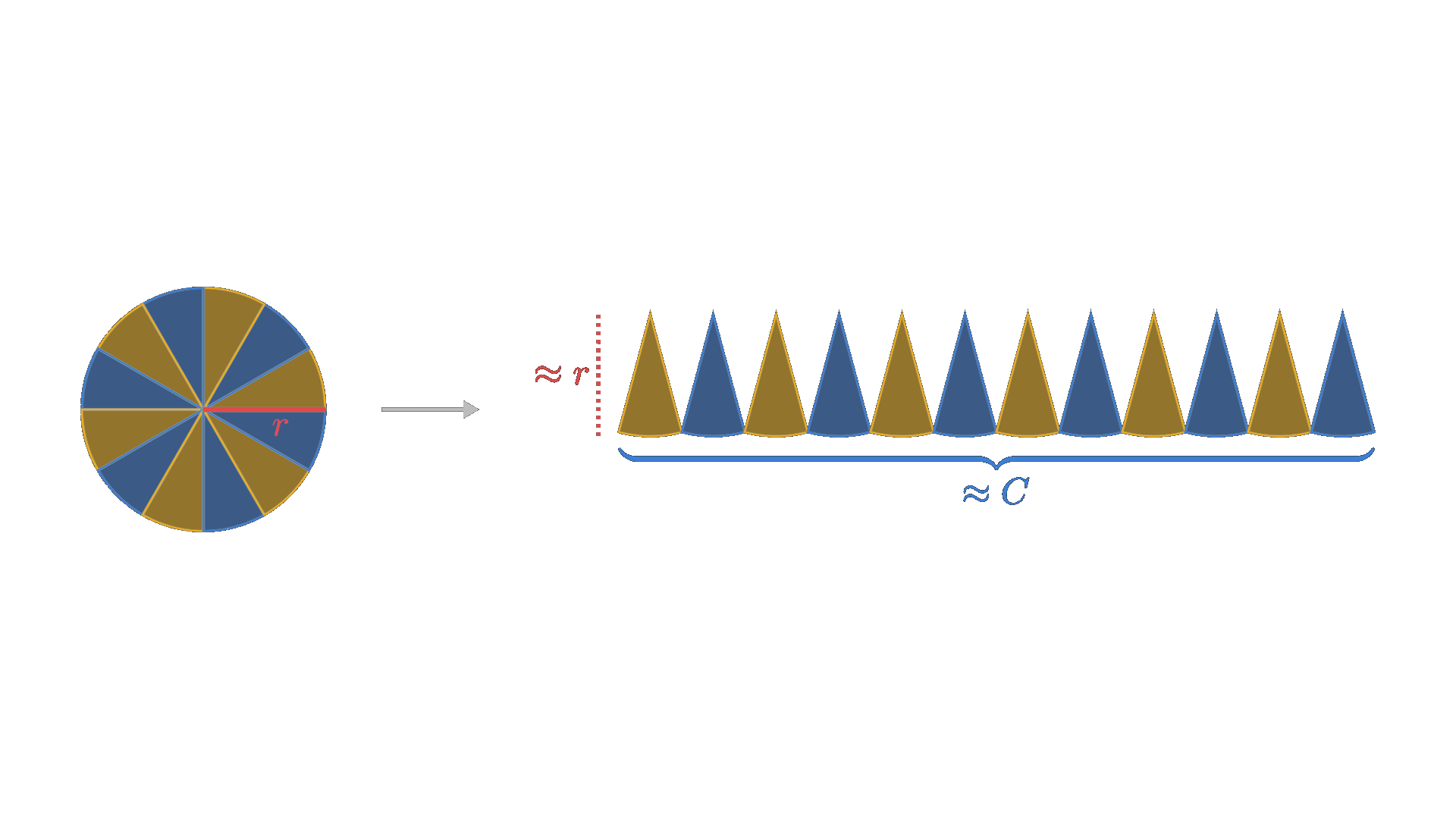
And here Euclid I.38 comes into play. Treat every slice as a triangle with base \(\tfrac{C}{n}\) and height \(r\). All the tips lie on the same line, parallel to the base, at height \(r\). So we may slide each tip along that line, without changing the area of its triangle, until all tips sit at one and the same point — say directly above the left end of the row. What we end up with is one big right triangle with base \(C\) and height \(r\), cut into many thin pieces.
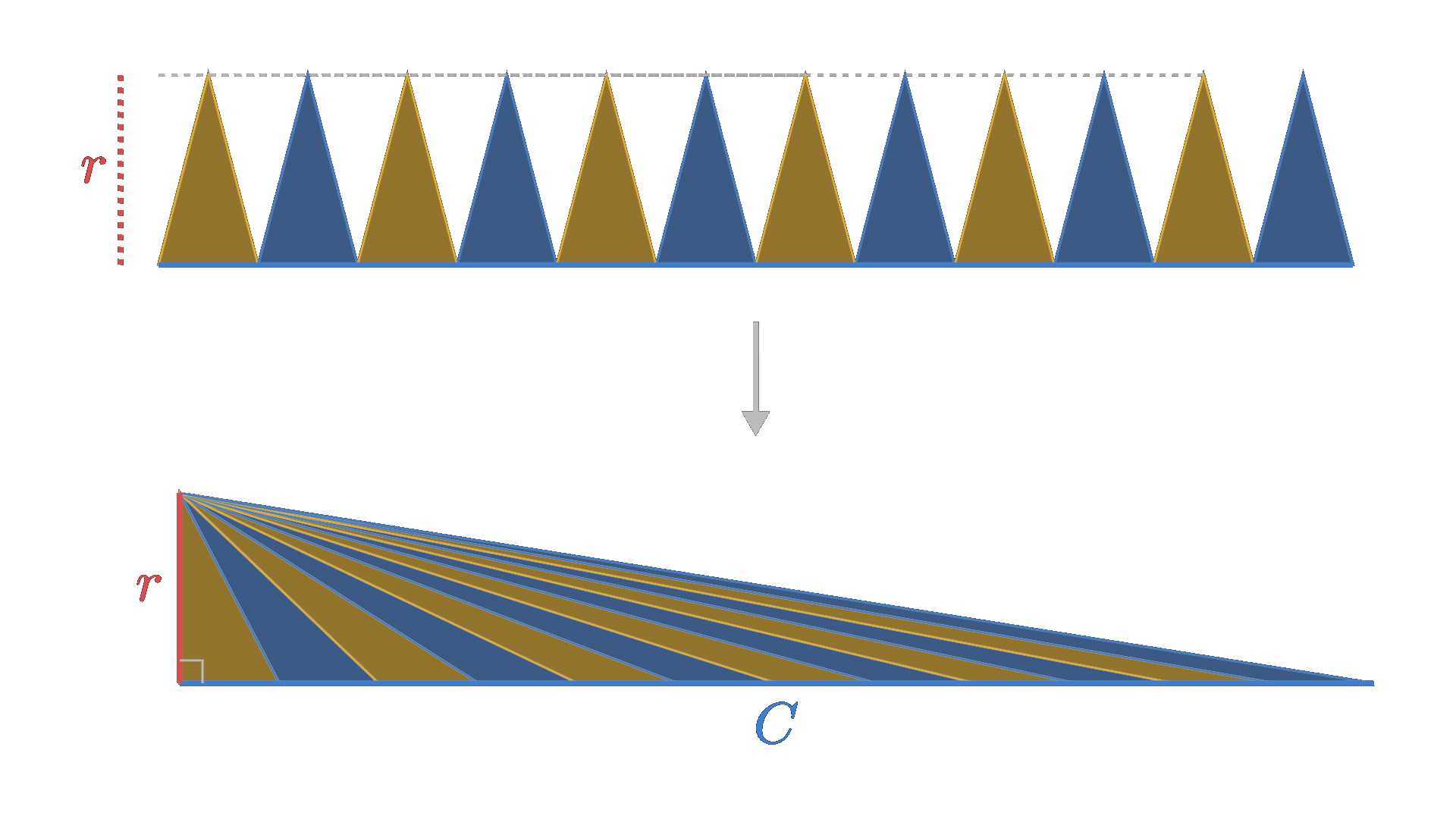
That is already the whole idea. The only catch is the word "almost". A slice is not a triangle: its base is curved, not straight. And if we replace the arc by the straight chord to get a real triangle, its height is no longer exactly \(r\) but a little less, and its base a little shorter than the arc. All of these errors get smaller the thinner the slices are, and in the limit of infinitely many, infinitely thin slices they disappear. That is exactly how Johannes Kepler argued in 1615, when he described the circle as consisting of infinitely many triangles, each with its tip at the center and its base on the circumference. But "in the limit" is a phrase no Greek geometer would have accepted as part of a proof — more on that below.
Peeling the Onion
Before we get there, let me show you one more picture, because I find it even more convincing than the slices. Instead of cutting the circle from the center outwards, cut it into thin concentric rings, like the layers of an onion. Then cut every ring open along one radius and straighten it out into a strip.
The innermost ring gives a very short strip, the outermost one a strip that is (almost) as long as the circumference \(C\). And because the circumference of a circle is proportional to its radius, the length of the strips grows linearly from the center to the outside. Stacking the strips on top of each other, the shortest at the top, therefore gives a staircase that approximates — once again — a right triangle with base \(C\) and height \(r\).
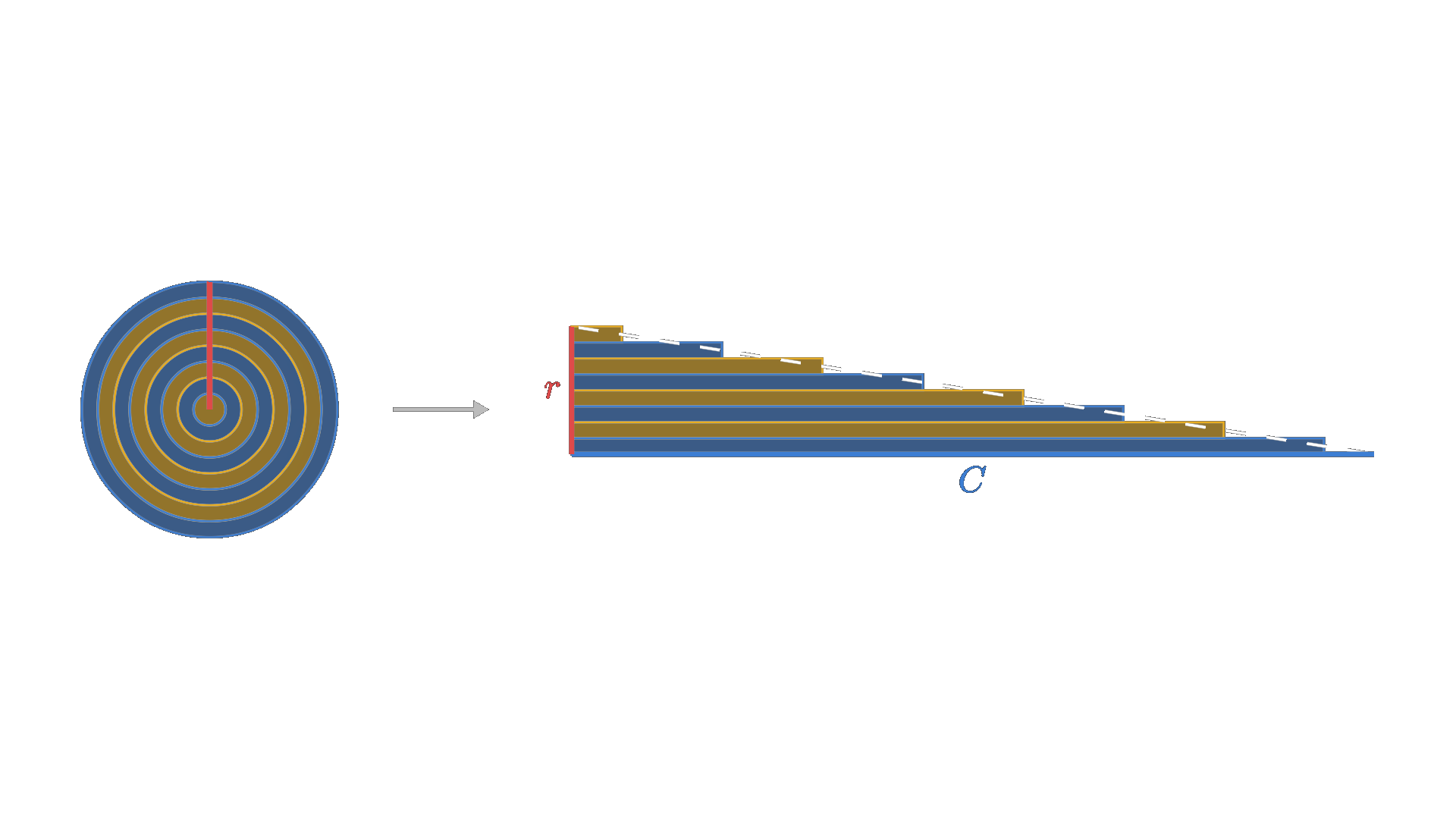
This argument is not Greek, though. It is usually credited to Abraham bar Hiyya, a Jewish mathematician of the twelfth century, who described the circle as being made up of very thin threads laid in circles. If you have read the Cavalieri story, the idea might also look strangely familiar: the rings are nothing but the omnes lineae of the circle, only bent. And the "linear growth turns into a triangle" step is the same move Cavalieri made with his pyramid of squares.
Both pictures share the same weakness, though. A ring is not a rectangle, and a slice is not a triangle. The argument only becomes exact once infinitely many, infinitely thin pieces are involved, and that was exactly the kind of reasoning the Greeks had banned from their proofs.
The Greeks and the Infinite
The Greeks were not unaware of this kind of idea. Already in the fifth century BC, Antiphon the Sophist suggested inscribing a square into a circle, then an octagon, then a polygon with sixteen sides, and so on, doubling the number of sides each time. Eventually, he claimed, the polygon would coincide with the circle, and since every polygon can be squared, so could the circle. Aristotle and his commentators rejected this flatly: no matter how many sides the polygon has, it never becomes the circle, there is always a little bit left between the two.
After the paradoxes of Zeno, the infinite was treated with great caution in Greek mathematics. An infinite process was something that could never be completed, so its "result" could not be part of a proof. What was needed was a way to make statements about curved figures by using only finitely many steps. And that way was found by Eudoxus in the fourth century BC: what we today call the method of exhaustion (the name is from the seventeenth century, not from the Greeks).
Its foundation is Proposition X.1 of the Elements: if from a magnitude more than half is taken away, and from what remains again more than half, and so on, then eventually a magnitude will remain that is smaller than any magnitude given in advance. Note how carefully this is phrased. It does not say that the remainder ever becomes zero, and it says nothing about infinitely many steps. It only says that for any given magnitude, no matter how small, there is a finite number of steps after which the remainder is smaller than that.
Exhausting the Circle
Let us see how this works for the circle and Antiphon's polygons. Start with the square inscribed in the circle. It takes up more than half of the circle: the square circumscribed around the circle is exactly twice the inscribed one, and the circle is smaller than the circumscribed square, so the inscribed square must be more than half of the circle.
Now double the number of sides. Over every side of the square we erect an isosceles triangle whose tip lies on the circle, halfway along the arc. What happens to the little circle segment between the side and the arc? Look at the rectangle over the side that reaches up to the tangent at the tip of the triangle. The triangle is exactly half of that rectangle (Euclid I.41 again), and the rectangle contains the whole segment. So the triangle takes away more than half of the segment.
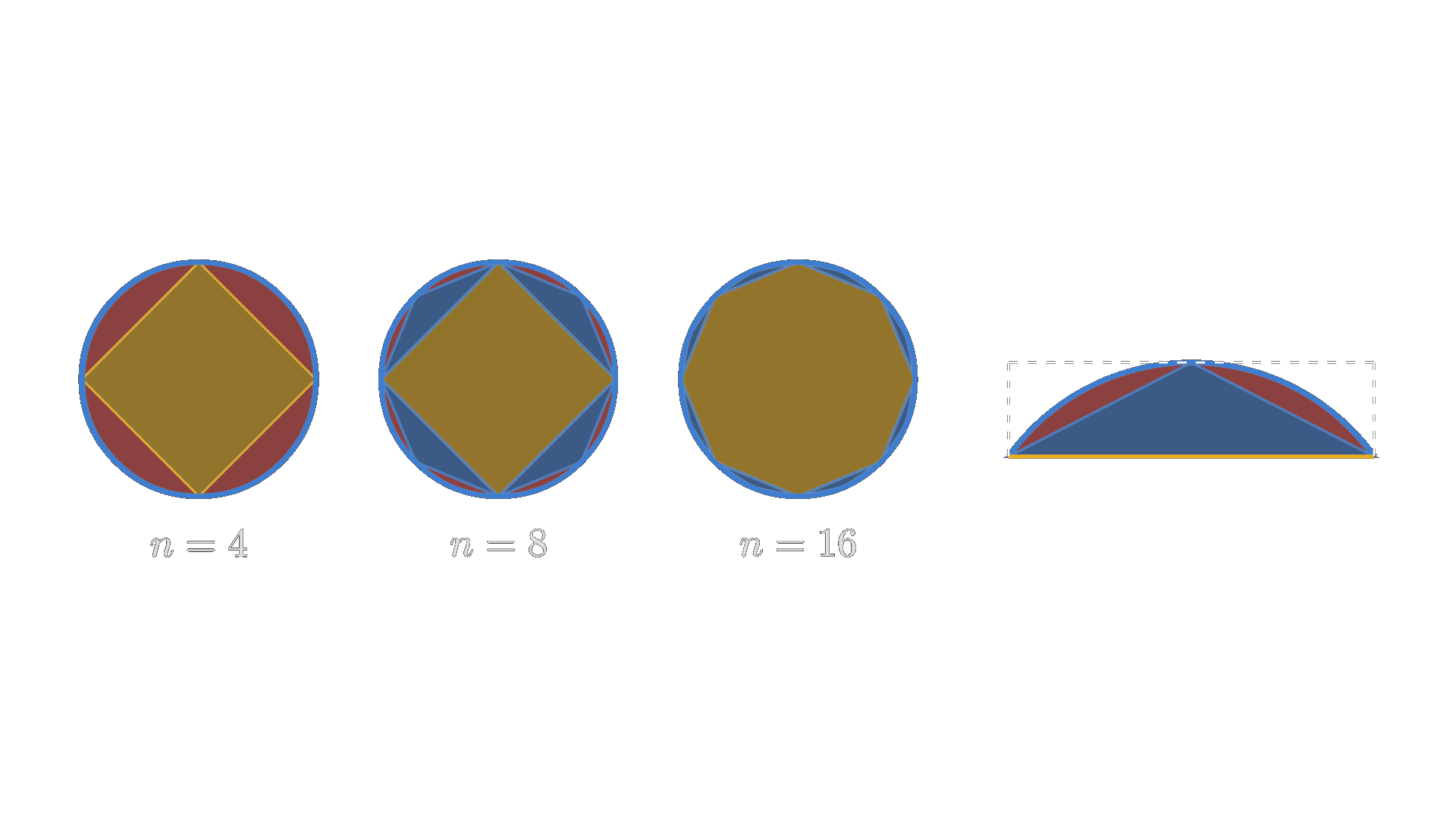
In the image above, the polygon from the previous step is drawn in yellow, the newly added triangles in blue and what is still missing to the full circle in red. And since the argument with the rectangle works for every segment at every step, each doubling takes away more than half of what was still missing. This is exactly the situation of X.1, so for any area you name, no matter how small, there is an inscribed regular polygon that misses the circle by less than that area. With a slightly more fiddly argument the same holds for polygons circumscribed around the circle: their excess over the circle can also be made smaller than any given area.
Notice what we have not said: that the polygons eventually become the circle. They never do. We only know that they can be made as close to the circle as we like.
Polygons are Triangles too
The second ingredient is that the slicing trick from before works perfectly for regular polygons — no "almost" needed. Cut a regular polygon into triangles from its center. Each triangle has one side of the polygon as its base, and all of them have the same height \(h\), the distance from the center to the sides. Slide all their tips together as before and we get a right triangle with height \(h\) and the perimeter \(p\) of the polygon as its base. This time the result is exact:
\begin{equation} P = \frac{1}{2}\,p\,h. \end{equation}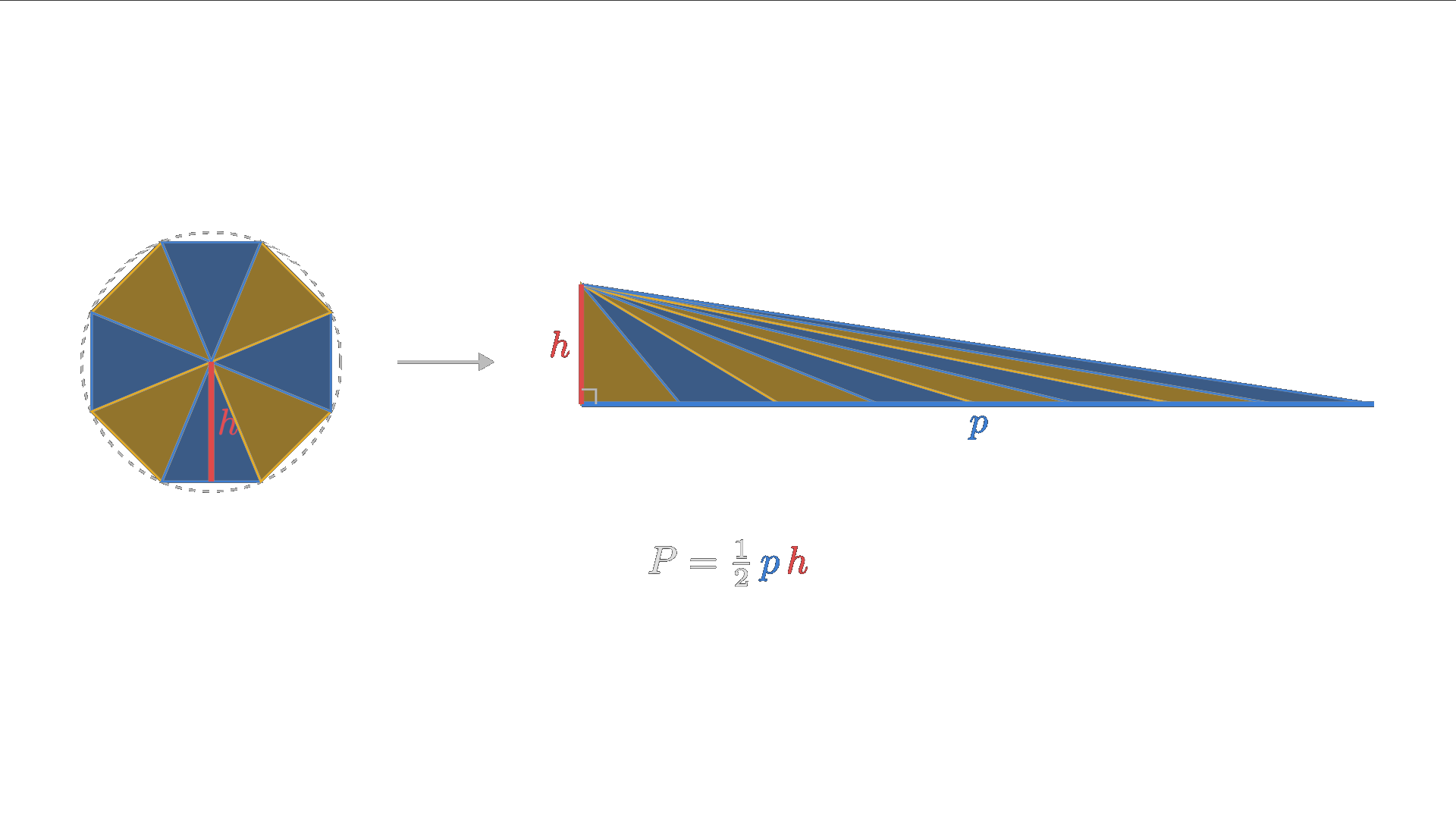
Now compare that with our triangle \(K = \tfrac{1}{2}\,C\,r\). For an inscribed polygon, the height \(h\) is smaller than the radius, and the perimeter is smaller than the circumference, since each side is a straight line between two points of the circle while the arc is a curved one between the same points. Therefore
\begin{equation} P_{\text{in}} = \frac{1}{2}\,p_{\text{in}}\,h \;<\; \frac{1}{2}\,C\,r = K. \end{equation}For a circumscribed polygon the height is exactly the radius, because each side touches the circle. Its perimeter, on the other hand, is larger than the circumference, and so
\begin{equation} P_{\text{out}} = \frac{1}{2}\,p_{\text{out}}\,r \;>\; \frac{1}{2}\,C\,r = K. \end{equation}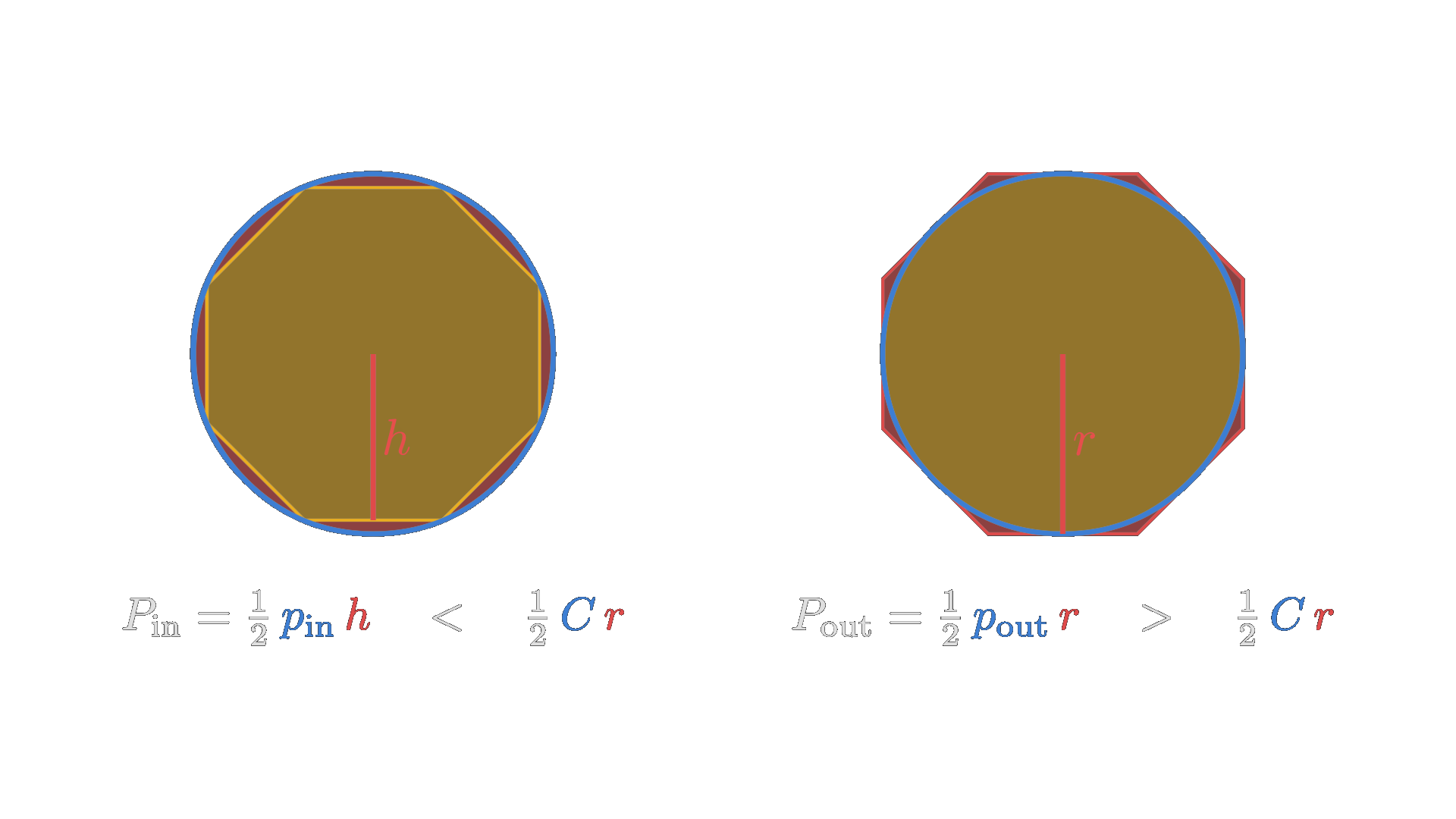
To be honest about it, the two comparisons of perimeters are not as innocent as they look. That the straight line is the shortest connection between two points, and that a convex curve which encloses another one is the longer of the two, are things Archimedes could not prove from Euclid's axioms. He simply stated them as assumptions at the beginning of his treatise On the Sphere and Cylinder. The same goes, by the way, for the very idea that there is a straight line equal in length to a curved one. For us that is obvious, but it is a remarkable step that Archimedes takes here without much fuss.
Archimedes' Proof
Now we have everything together, and the proof itself is short. Let \(A\) be the area of the circle and \(K\) that of the triangle with base \(C\) and height \(r\). There are only three possibilities: \(A\) is larger than \(K\), smaller than \(K\), or equal to it. Archimedes rules out the first two, which is why this kind of argument is called a double reductio ad absurdum.
Suppose \(A\) is larger than \(K\). Then the difference \(A - K\) is some definite area. By the exhaustion argument there is an inscribed regular polygon that misses the circle by less than this difference, that is \(A - P_{\text{in}} < A - K\). But that means \(P_{\text{in}} > K\), and we have just seen that every inscribed polygon is smaller than \(K\). Contradiction.
Suppose \(A\) is smaller than \(K\). Then \(K - A\) is some definite area, and there is a circumscribed regular polygon that exceeds the circle by less than that, that is \(P_{\text{out}} - A < K - A\). So \(P_{\text{out}} < K\), but every circumscribed polygon is larger than \(K\). Contradiction again.
So the circle can neither be larger nor smaller than the triangle, and therefore it is equal to it.
It is worth pausing for a second to appreciate how clever this is. Nowhere in the proof is there an infinite process. Nobody claims that a polygon turns into the circle. All we ever do is take a finite polygon to refute a claimed difference between \(A\) and \(K\). Whatever gap someone suggests, we can produce a polygon that shows the gap cannot exist. If that reminds you of the \(\varepsilon\)-arguments from a modern analysis course, it should: the difference \(A - K\) plays exactly the role of the \(\varepsilon\), and the number of sides that of the \(N\) we have to find. It took mathematics until the nineteenth century to bring limits back to this level of rigor.
The flip side is that the method only proves a result that one already has to know. It gives no hint at all of where the triangle came from. This is exactly what Cavalieri and others complained about, as we discussed in the Cavalieri story: the finished Greek proofs hide the road to discovery. Archimedes most likely had something like the slicing picture in mind first and then dressed it up in the method of exhaustion. That he worked like this is not just speculation: in his Method, a letter to Eratosthenes that was only rediscovered in 1906, he explains openly how he used such heuristic, "mechanical" considerations to find his results before proving them rigorously.
Conclusion
Returning to the question from the beginning. Remember Euclid XII.2: the ratio \(\tfrac{A}{d^2}\) is the same for all circles, and since \(d = 2r\), so is \(\tfrac{A}{r^2}\). Let us call this number \(k\) for the moment, so that \(A = k\,r^2\) for every circle. Euclid does not tell us what \(k\) is, and he says nothing about the circumference at all. Now we add Archimedes' theorem:
\begin{equation} k\,r^2 = A = \frac{1}{2}\,C\,r \quad\Longrightarrow\quad C = 2k\,r = k\,d. \end{equation}Two things follow at once. First, the ratio of the circumference to the diameter is the same for all circles. Apart from the assumption we already met, that a circumference can be measured by a straight line at all, nobody has to take this for granted: it follows from Euclid XII.2 together with Archimedes' theorem. Second, and this is the answer to our question, that ratio is the same number \(k\) that appears in the area formula. Today we call this number \(\pi\), a name that only came into use in the eighteenth century, and write
\begin{equation} C = \pi d = 2\pi r \qquad\text{and}\qquad A = \pi r^2. \end{equation}The \(\pi\) in the area and the \(\pi\) in the circumference are one and the same number because the circle is "made of" triangles whose height is the radius and whose bases add up to the circumference.
Archimedes did not stop there. In the third proposition of the same treatise he calculated the perimeters of inscribed and circumscribed regular polygons with 96 sides, using nothing but the theorem of Pythagoras and a lot of patience with square roots, and obtained
\begin{equation} 3\tfrac{10}{71} \;<\; \pi \;<\; 3\tfrac{1}{7}. \end{equation}That is \(3.1408\ldots < \pi < 3.1428\ldots\), and the upper bound \(\tfrac{22}{7}\) remained the standard value for practical purposes for many centuries. Exact, purely arithmetic expressions for \(\pi\), though, had to wait almost 2000 years when Madhavas, John Wallis, Newton and others derived the first infinite products and series for pi.